Caribbean Sea Turtles are the Oldest Species on Earth!
Caribbean Sea Turtles are the oldest species and they always go back to their first beaches where they ventured or born. The temperature determines whether the born turtle will be a female or a male.
Sea turtles have existed for millions of years, and they spend their entire lives in the sea. Only females come ashore and venture onto beaches for few hours once or twice every two years to spawn on sandy beaches.
Here they lay their eggs in 40-50 centimetres deep holes and cover them with sand before returning to the sea.
The following article is about the Caribbean Sea Turtles. If you have more information about them, please use the form at the bottom of the page to write it. I will reward you by some good e-books to read just for knowledge or to use and benefit from them. Thanks.
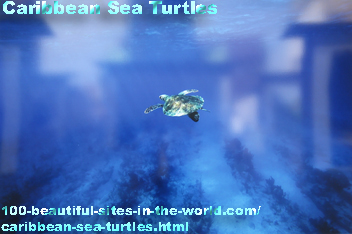
Although they are found in considerable numbers in most tropical and subtropical waters in the world, many species of the very highly endangered sea turtles became vulnerable to some threats from the changing nature.
Four of the species, specially the hawksbill turtle live in the Caribbean Sea, where they find food and mate between the corals and breed on the sandy beaches of Barbados in the east to Mexico in the west and from Florida in the north to southern Colombia.
The hawksbill turtle is one of the smaller sea turtles among these species here. It will be about 1 metre long and weighs up to 120 kilograms.
When the hawksbill turtle, like other sea turtles are under serious threat, not only because it has for centuries been a trophy and a delicacy that has been hunted by humans, other facts like the changing weather events threat them.
In recent years, global warming was a serious new threat to its survival.
Rising sea levels, rising seawater temperature, acidification of the seas and more extreme weather events can slowly destroy the coral reefs where the Caribbean Sea turtles live; forage and breed, and it can erode the beaches where the females lay their eggs.
Sea turtles cannot just find another beach or a new rev. Although they walk out migrating one hundred or thousands of miles and can take up to 30 years to reach maturity, they always come back to the same beach where they were hatched to mate and spawn.
Heating of the beach is also a threat. Turtles have no sex chromosomes. It is the ambient temperature of the sand surrounding the eggs, which determines whether the turtles come out of the buried eggs as males or females.
The higher sand temperature is the shorter the incubation period and the greater the likelihood that turtle kids come out as females.
An increase in sand temperature can cause a dramatic decrease in the number of male sea turtles. This will pose a severe threat to the survival of one of the oldest living animal species on the planet.
You can either comment on this article about the Caribbean Sea Turtles or write your own.
To do so, please use the following form and contribute to this page. It is good idea to leave your email address so you can receive any reply to your comments.
PLEASE BE ASSURED, no one of the commentators will capture your email address. It is only that the system that will send you notifications about replies to your comments, as this process is automated.
I have some gifts for you too for sharing your words about the Caribbean Sea Turtles or any beautiful location on the Caribbean Sea and the affects of global warming on those locations. Thanks.
Have A Great Story About Some Beautiful Sites in the World?
Do you have a great story about any beautiful site in the world? Share it!
What Other Visitors Have Said
Click below to see contributions from other visitors to this page...
Bequia in the Grenadines! Not rated yet
My son was recently married in Bequia in the Grenadines 2 weeks ago We visited the Lower beach to swim and amazingly we saw a nest of turtles hatching …
Search inside any beautiful location on the Caribbean Sea.
You can also enjoy more activities here if you liked this page about the Caribbean Sea Turtles.
Please share it with your services through the buttons here, at the left column of the page and at the bottom of the page.
This could be also additional value to you, as you could experience some social networking technologies and know more. Click on "Enjoy this page? Please pay it forward" at the bottom to know how to link to the website.
I use "Solo Build It" tools at the bar below to empower this page about the Caribbean Sea Turtles and the entire 100 Beautiful Sites in the World. Thanks to those strong website building and optimizing tools.
Home| 100 Beautiful Sites Blog| Beautiful Site Map| Beautiful Scene Newsletter| 350| Amman| Archipelago Sea| Bayan Olgii| Big Sur| Boreal Forest| Borneo| Cape Floral Region| Caracas| Caribbean Sea Turtles| Chacaltaya| Congo River Basin| Copenhagen| County Meath| Dalarna| Franz Josef Glacier| Ganges Delta| Gondar| Ilulissat| Indus River| Kauai| Kilimanjaro| Kordofan| Lake Chad| Lilongwe| Madagascar| Mergui Archipelago| Monteverde Cloud Forest| Naukluft Park| Niger Delta| Norwegian Tundra| Okavango Delta| Olympia| Panama Canal| Paris| Perth| Quelccaya Ice Cap| Recife| Rio de la Plata| Rotterdam| Rub al-Khali| Sagarmatha National Park| Saint Louis| Solomon Islands| Sulu Sulawesi Sea| Thames| Tian Shan| Timbuktu| Tokyo| Trinidad| Tuvalu| Upper Po Valley| Valdes Peninsula| Vavau| Yamal Peninsula| Yangtze River| Zahara de la Sierra|
Recent Articles


-
Hannovers Nature Escape: Forest & Garden Therapy for Mindful Healing!
Mar 29, 25 09:01 AM
 Hannover’s Nature Escape: Forest & Garden Therapy! How Nature's Dual Remedy: Forest & Garden Therapy Restores Your Inner Power?
 -
Meditation in Hannover: Serenity for the World!
Mar 22, 25 09:11 AM
 Meditation in Hannover: Serenity for the World! A unique blend of cultural vibrancy & natural tranquility. For travelers seeking peace & mindfulness...
 -
Look India Hotel Offering Affordable Price Hotel Booking & Holiday Packages Deals!
Mar 11, 25 10:06 AM
Traveling is an idea that can be made quite exciting by including family and friends. In recent times, it is seen that a large number of people are facing